




Why are grey whales dying?
2022-03-31

Why are grey whales dying? Intelligence and resilience have enabled Grey Whales navigate life in the ocean, but their home is changing rapidly… and even these adaptable mammals are struggling to cope.
FROM A CNN News Article
An international team of academics, biologists, and volunteers has been examining this mystery, known as an Unusual Mortality Event (UME). But what is a UME? The Marine Mammal Protection Act defines it as involving a “significant die-off of any marine mammal population…”. Sadly, it’s been annihilating one of the world’s toughest survivors: the northern Pacific Grey Whale. What did they learn?
Understanding Grey Whales
Grey whales’ coastal migration is responsible for much of what we know about them. On clear days, and with patience, it’s possible to spot gray whales along much of their 10,000-mile round trip from Alaska to Baja California, Mexico.
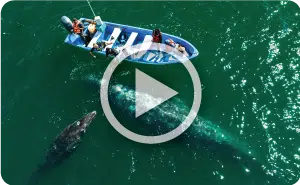
However, the final leg of their journey to San Ignacio Lagoon provides an excellent opportunity to learn more about them. Researchers are utilizing drone photos to evaluate the body weight and health of grey whales over winter in Baja California. Individual whales are identified, and they track the frequency and duration of their visits to the lagoon. This also enables other organizations to identify these whales should they end up washed up along the coast.

Is Climate Change Impacting Their Feeding Habits?
While the exact origin is unknown, many academics attribute altered feeding habits to the fast-changing environment in and around the Arctic Ocean. The ecology is affected by melting ice sheets and rising waters, among other factors. Understanding how the Arctic ecosystem is changing could disclose yet another piece of Earth’s biosphere that has been affected by climate change.
By the end of May 2019, the National Oceanic and Atmospheric Administration (NOAA) had identified an unusually high number of grey whales washed up on the eastern Pacific coast of Mexico, the USA, and Canada. Many of the whales observed during the past seasons were very malnourished; this type of malnutrition is uncommon.

Source: Fredrick Christiansen, Fabian Rodríguez-González, Hunter Warick
The filter-like baleen in whales’ jaws allows them to catch large amounts of prey. But there is one major snag. These migrating marine mammals eat tiny fatty crustaceans in the northern waters before completing the journey south to Baja. However, many of them have been forced to leave their feeding grounds in poor nutritional condition. Starting their epic migration somewhat malnourished makes it nearly impossible for them to return after the breeding season.
“A temperature change affects the speed of currents. Slower waters imply more fine silt reaches these sea creatures on the ocean floor. Faster currents carry these small particles farther away from the sea bug’s habitat, similar to how blowing winds carry fall leaves. Sediment accumulates on the amphipod populations without the “wind.” The ability to build content little lives in the mud is harmed by higher levels of fine sediment.”
“My money’s always on grey whales.”
Let’s not forget, commercial whaling had nearly wiped off the Pacific greys until the International Whaling Commission prohibited the activity in the United States in 1971 and then internationally in 1986. Whales were no longer endangered in 1994. They’re a resilient species, which contributes to their prosperity. In the 1700s, the Atlantic grey whale was declared extinct. However, in 2021, a lone male grey whale was discovered swimming in the Mediterranean Sea, starving. Surviving as a species for 200,000 years on this planet can have that effect. Grey whales have figured out how to do it.
“My money’s always on grey whales,” said Sue Moore. “As I’ve said — now maybe too many times — they don’t call them robustus for nothing. They are a robust species.”

Whales migrate to the lagoon between January and April. We invite you to join us in this extraordinary part of the world where we are lucky enough to see these gentle giants and their newborn calves.
Contact us for more information or read more about this unique experience here.