
Touching Gray Whales: Unique Encounters in Baja California Sur
Touching gray whales… The question isn’t really whether we can touch them.
The deeper question is: should we?
“2025 marks Baja Expeditions’ 35th year of running gray whale camps in San Ignacio Lagoon. The whale encounters here are extraordinary and truly unique on our planet. Our fly-in camps offer glamping and luxury options, fine dining, 24-hour power, and the incredible Mexican night sky filled with stars. The question in my mind is not “Can we touch gray whales?” but rather “Should we touch these beautiful animals?”
by Captain Mike, Baja Expeditions
Touching Gray Whales: What You Need to Know Before the Experience
Every winter in San Ignacio Lagoon and other protected lagoons of Baja California, gray whales do something extraordinary. Out of the 5,000–6,000 whales that migrate here each season, perhaps 400 choose to approach boats inside a small, regulated whale-watching zone.
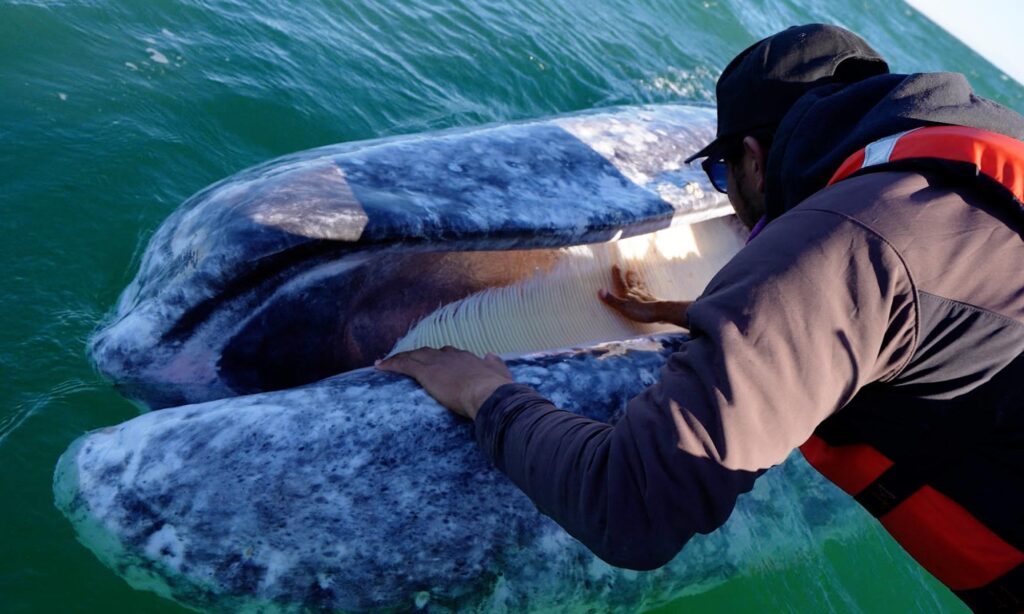
Some whales initiate contact. And sometimes, they linger, inviting a gentle touch.
This is not staged wildlife. It is not trained behavior.
So, can we touch these gray whales? Yes. Certainly. But always on the whales’ terms.
What Does “Touching Gray Whales” Really Mean?
It’s important to understand that touching gray whales does not mean chasing them, swimming with them, or reaching out into open water hoping for contact.
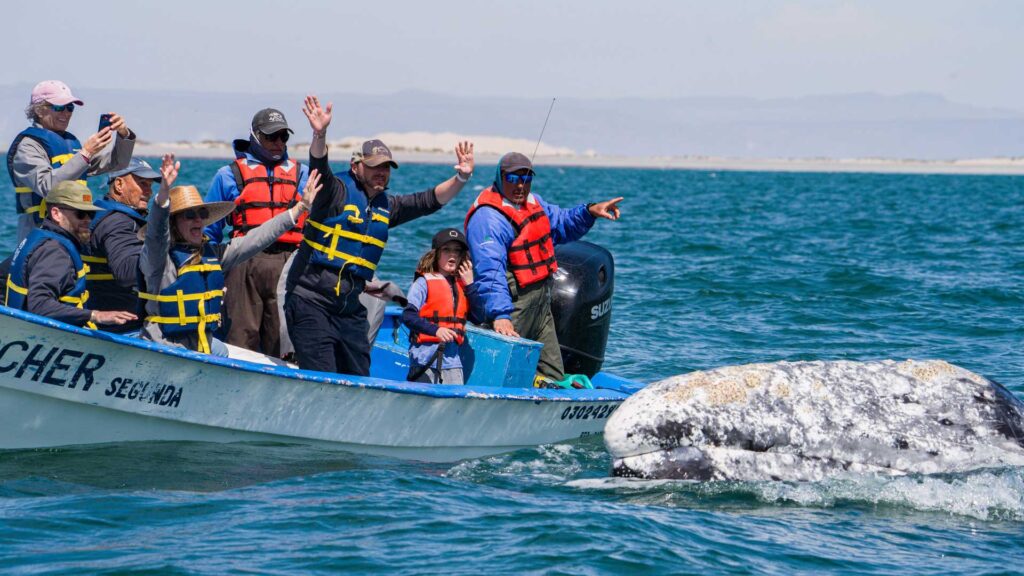
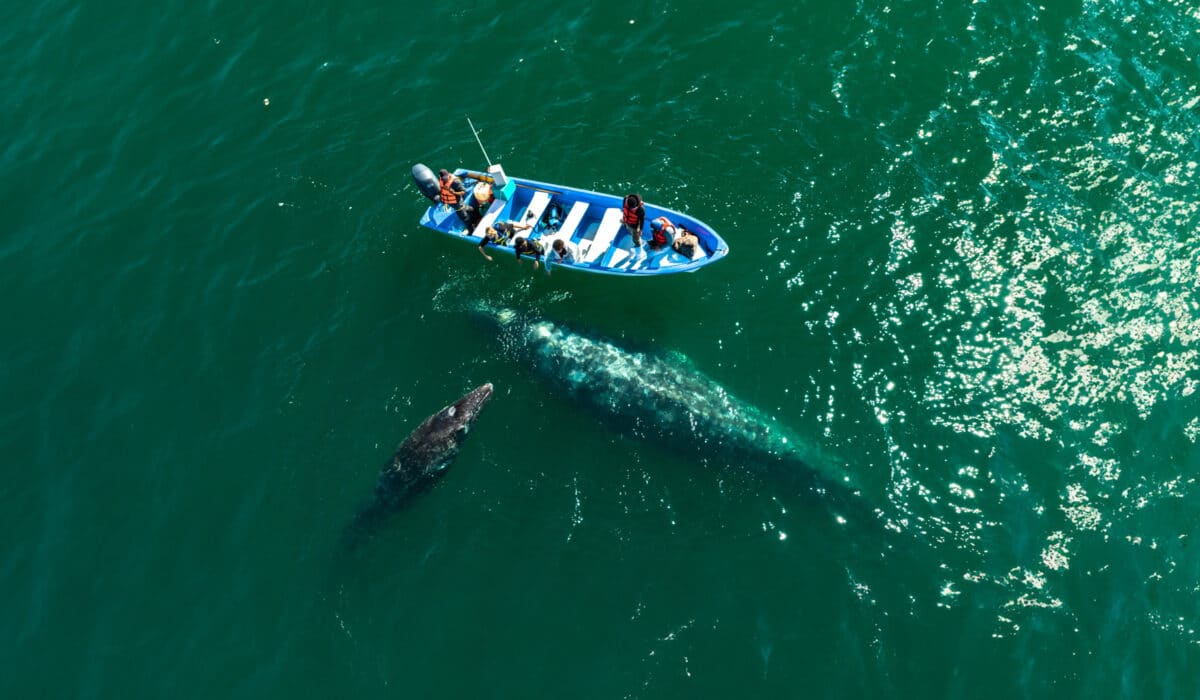
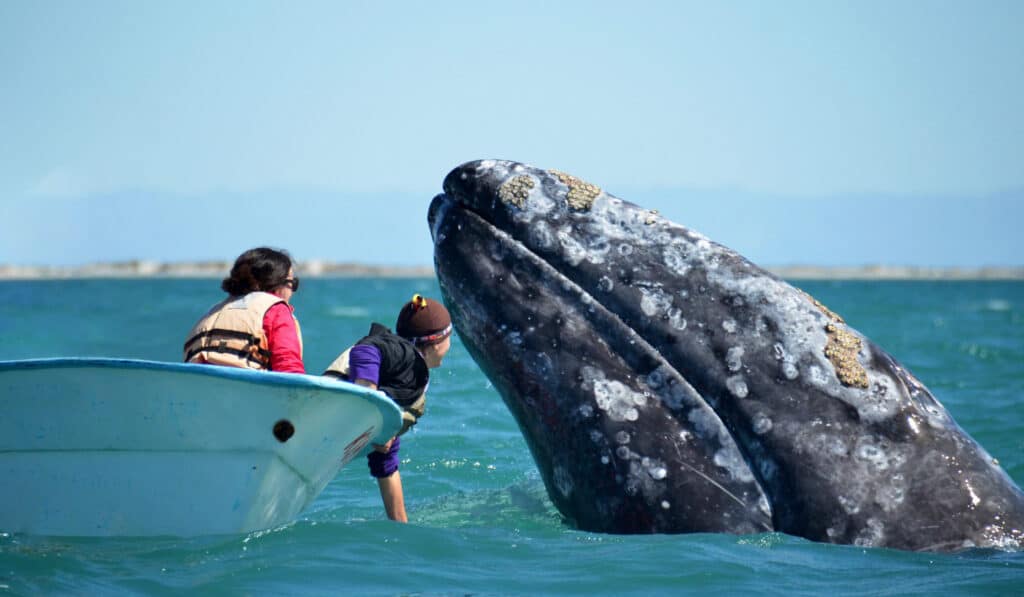
All interactions happen from small skiffs, known locally as pangas. Boats remain in a restricted viewing zone. If a whale approaches and positions itself beside the boat, guests may gently touch its rostrum or back — briefly and respectfully.
If the whale doesn’t want interaction, it simply leaves.
Everything happens on their terms.
Where and When Can You Touch Gray Whales?
Interestingly, this close interaction behavior is almost exclusively observed in these Baja lagoons. Across their vast migration along North America’s coast, documented encounters elsewhere are extremely rare.
“I have only heard of one close up gray whale encounter outside of Baja. That was on the west coast of Vancouver Island, where a gray whale rubbed up against a small boat and allowed the boaters to rub its back. Maybe it had an itch? A friend’s son, a local whale guide with a lot of experience, was in the skiff, and forwarded the video to me. Super cool behaviour, but different than what we experience… and it only happened once.”
by Captain Mike, Baja Expeditions
Touching gray whales and the close-up encounters are a phenomenon. One which only occurs in a few protected birthing lagoons along Baja California’s Pacific coast, namely:
- San Ignacio Lagoon
- Magdalena Bay
- Ojo de Liebre Lagoon
The best time to visit Baja depends on what you want to see and do. But for whale watching, the season typically runs January through April, when gray whales arrive in Baja after migrating thousands of miles from Arctic feeding grounds to mate and give birth.
Why Do Gray Whales Approach Humans?
This behaviour is only commonly reported in Baja California’s protected birthing lagoons, especially in San Ignacio Lagoon. Here, the first known friendly interaction dates back to 1972, when a local fisherman — named “Pachico”, the lagoon’s original whale whisperer — reached out to touch a whale that surfaced beside his panga. At the time, gray whales were known as “devil-fish”, and local fishermen feared them.
But that whale pushed gently into his hand.
Word spread among fishermen. And perhaps among whales, too.
Over time, more whales began approaching boats.
Why? This question fascinates scientists and travelers alike. Although we can’t say for sure, let’s take a look at some contributing factors:
- Curiosity: Gray whales are naturally inquisitive.
- Calm nursery waters: The lagoons are shallow and predator-protected.
- Learned safety: Decades of respectful, regulated whale-watching have reinforced that boats here are not a threat.
- Generational familiarity: Mothers that once approached boats may now return with calves.
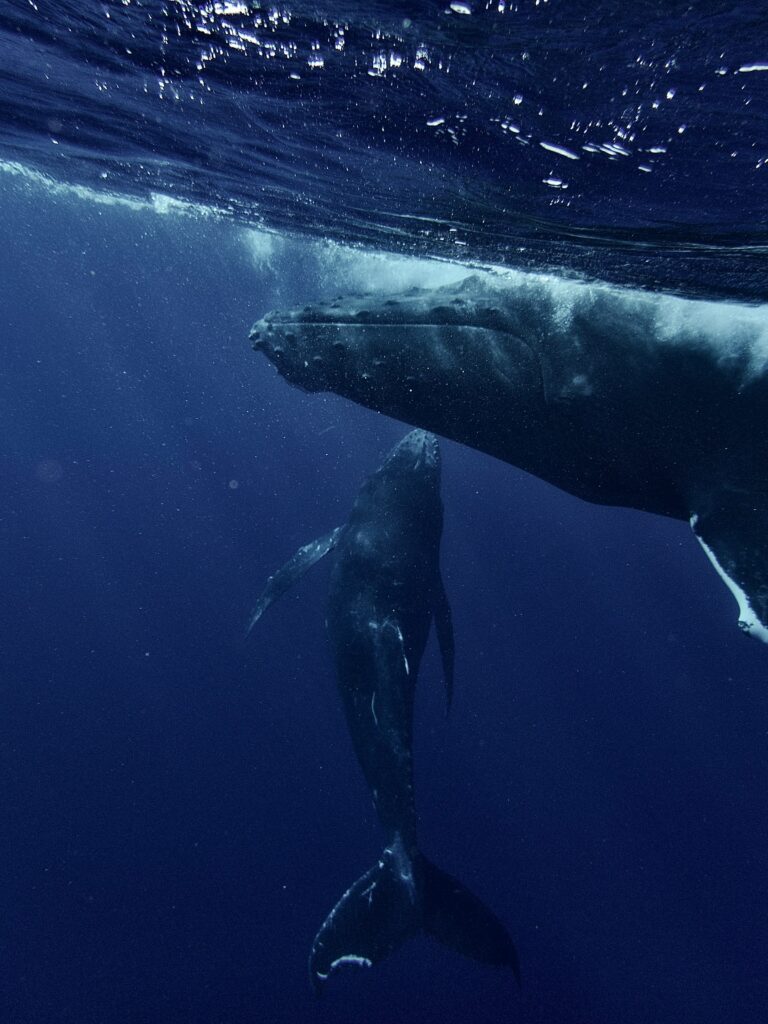
- Calves are often the boldest, sometimes approaching boats first, under their mother’s watchful eye.
Importantly, these whales are not fed, trained, or conditioned through rewards. Their behavior appears voluntary and sociable.
Find out why gray whales were once named “devil-fish” and more in our ‘10 Fun Facts You Didn’t Know‘ blog.
Are We Changing Whale Behavior by Touching Them?
This is a fair concern and a crucial question.
Long-term studies in Baja’s lagoons suggest that gray whales continue to display natural behaviors: mating, nursing, resting, and socializing. Observations suggest that respectful whale watching has no measurable impact on their reproductive success or migration patterns.
However, this balance depends on respectful encounters and responsible operators. For example, San Ignacio Lagoon is about seven miles long, and only a small portion of that space is designated for whale watching. No whale-watching occurs elsewhere in the lagoon.
If whales don’t want to engage, they simply swim to another area.
Given that gray whales only display this close behavior in Baja’s birthing lagoons — and not along the rest of their migration route — suggests the interaction is situational.
Are Whales Stressed by Our Interactions?
Stress in marine mammals can be measured through avoidance behavior or changes in breeding, eating, and movement patterns. Luckily, there is no evidence to suggest this is happening in Baja’s regulated lagoons. Whales are not stressed by our interactions because the whales control the encounter. Boats are required to remain passive and to never chase or pursue whales.
The whales approach. They chose to linger, sometimes for extended periods, indicating a certain comfort level. When they are ready, they leave.
There is also a subtle communication at play. Qualified guides watch closely for signs of fatigue or overstimulation and adapt the interaction as needed.
It may sound mystical, but experienced locals speak of energy and intention. Whether science measures it or not, whales seem selective. Some guests experience prolonged eye contact. Others do not.
Looking into the eye of a gray whale — close enough to see detail and awareness — is something few people ever forget.
“I’m not religious, but the old-timers say that you see G*d in the eye of a gray whale, and I believe it. To look into the eye of a gray whale is something you will never forget.“
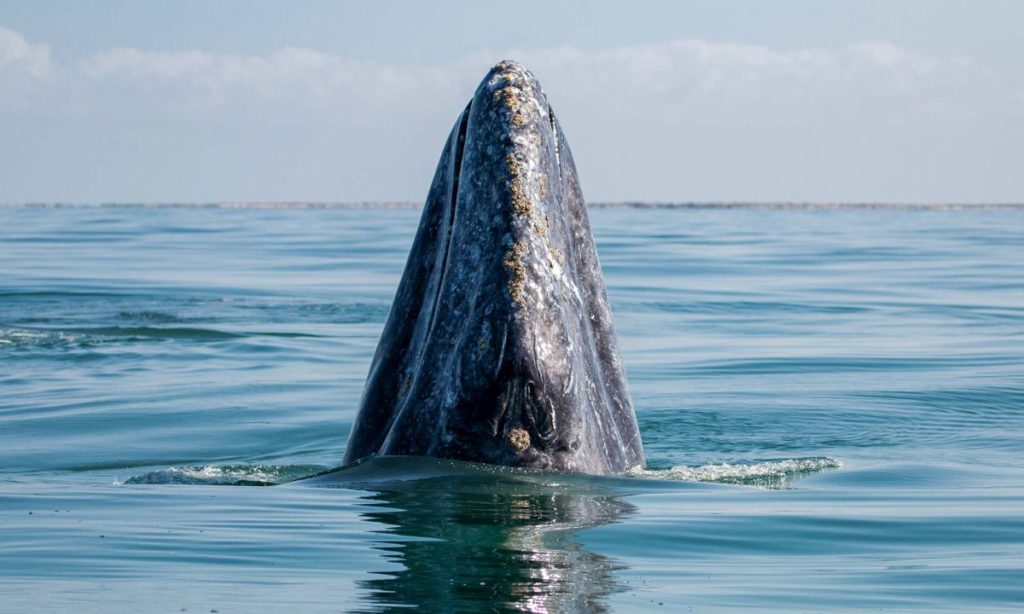
Could Touching the Gray Whales Harm Them?
To us, this is perhaps the biggest question. The most basic answer is that contact with gray whales should always be gentle and minimal.
Touching any wild animal carries theoretical risks, including:
- Bacterial transfer or disease transmission (one of the reasons why swimming with them is not allowed)
- Disturbance to resting mothers and calves
- Accidental contact with sensitive areas
There are no known cases of humans causing illness in gray whales. Still, precautions matter. If you are sick, coughing, or sneezing, do not interact with the whales. Stay onshore and enjoy some rest and recovery time.
To minimise risk, guests are encouraged to:
- Wash hands thoroughly and rinse off soap residue
- Avoid contaminating the water with sunscreen or chemicals
- Use biodegradable, reef-safe products
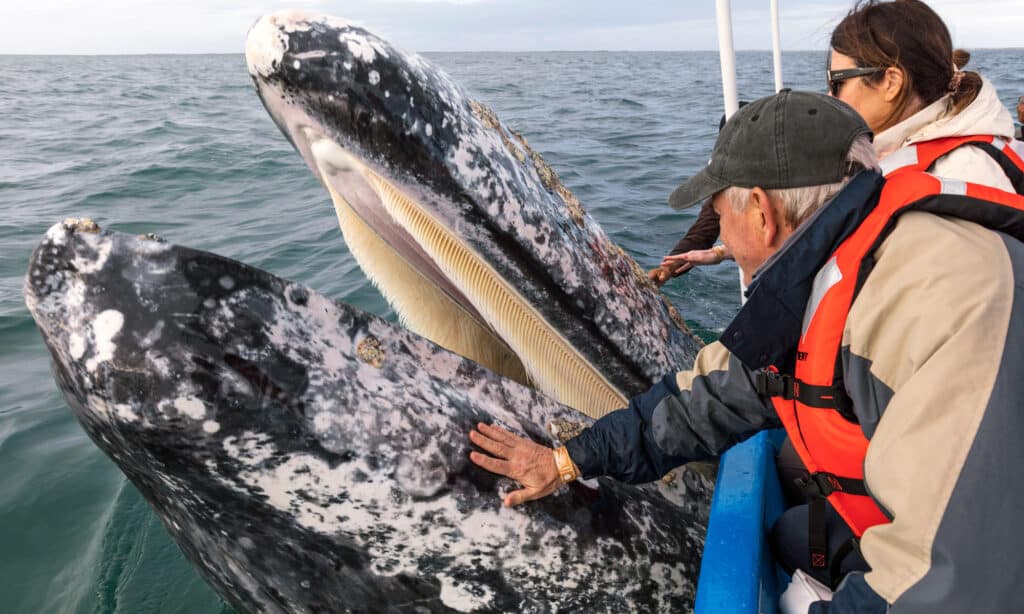
Is It Safe for Humans to Touch Gray Whales?
Gray whales can weigh up to 40 tons. Even a newborn calf weighs more than a car. Despite their size, whales in the lagoon are usually calm and slow-moving. Still, they are wild animals, and safety is maintained by following a few simple guidelines:
- Remaining seated unless instructed
- Following guidance from the captains and naturalists
- Avoiding sudden movements
- Keeping hands clear unless the whale is directly alongside
Incidents are extremely rare, largely because the whales control the interaction.
Ethical Guidelines for Touching Gray Whales
If you are fortunate enough to experience touching gray whales, remember: let the whale initiate everything and keep physical contact brief and gentle. Never reach toward their eyes or blowholes, and avoid leaning dangerously over the boat.
Always respect mother-and-calf pairs. These are the whales’ ancestral birthing lagoons, and they should always be treated with special consideration.
And if no contact occurs, embrace the chance to simply observe these incredible animals in their natural environment. Either way, be present in the moment.
Regulations and Rules Around Interacting With Gray Whales
There are clear whale-watching regulations enforced in Baja’s lagoons. These regulations include:
- Licensed captains only
- Limited boats per whale group
- Time restrictions
- No swimming with whales
- No chasing or encircling whales
Following these rules when it comes to watching and touching gray whales is precisely why this rare phenomenon continues. The fact that gray whales continue approaching boats year after year suggests they do not perceive these encounters as threatening. With responsible operators and respectful guests, we hope this will continue for generations to come.
Reflections from Close-Up Gray Whale Encounters
Touching gray whales touches our souls, too. Looking into the eye of a gray whale beside the boat changes how many people see these animals — and the ocean — forever.
For those who have spent time in the lagoons, it’s also impossible not to think about the challenges gray whales have faced in recent years. The unusual mortality event several years ago was a sobering reminder of how vulnerable even these resilient animals can be. (You can learn more in our ‘Why are gray whales dying?’ blog.)
And yet gray whales are survivors. They have been adapting and evolving for more than 50 million years.
When a gray whale chooses to approach our boat, even allowing a gentle touch, it reminds us of our connection to the natural world — and of our responsibility to protect it.
— Captain Mike, Baja Expeditions